I haven't wanted to say it aloud, for fear of jinxing it or scaring it away like a wild deer (though not the deer in my neighborhood that stare at me and go back to nibbling my roses). But it IS a pretty huge milestone. Eva's wearing panties! No diapers. I am beyond happy. Beyond.
I can't say we did anything to make this happen, this time around. Just all the stuff They say to do: potty books, potty video, go with Mommy to potty, little potty chair, set up a routine, talk about it a lot--but not with any pressure! Yeah, we did all of that since she was 2 1/2 and had her first stint of success. But she protested fiercely; it went away. Back and forth a few times. I was out of ideas and tricks; she was getting too old to buy into the games and has never been one to be motivated by bribes. They say it'll happen when the child is ready--and not before. I had to let it go and trust.
Over the summer, I started telling her, matter-of-factly and without blame or guilt (I hope) that I was done changing her diapers. I didn't want to do it anymore. I refused to read her potty books to her the sporadic times she was sitting, saying I didn't think she needed it anymore. She was a big girl and could do this on her own. After a bit, I think she started to believe me.
In many ways, teaching her to use the potty was no different than teaching a typical child. One thing that differed was that her gross and fine motor skills are not as refined as a typical child. So while I was waiting for her to take an interest in using the potty, I worked with her, outside of the bathroom and without mentioning the potty, on the skills she needed to be successful. Signing "toilet" before she could speak (language). Practicing standing up and sitting down, over and over (gross motor). Getting pants on and off (fine motor). She would "help" me go and tell me what to do next. She would flush the toilet for me. She knew what to do, she just needed that secret motivator to get her to do it.
I think peer pressure at school this year did the trick. And the staff work hard with the kids to learn to use the toilet and stay dry. The other two girls in her Supported Kindergarten wear pretty panties and she wanted to be like them. One day, several weeks ago, she came home from school and said she wanted to wear pretty panties, too. OK! We gathered up some hand-me-downs, bought some exciting new Tinkerbell panties and that was it! The first couple days were a little rough, but after that, she has done amazingly well. It's been rather easy (if you don't consider the five years and nine months of diapers before that, but who's counting). Hooray Eva!
Showing posts with label awareness. Show all posts
Thursday, December 2, 2010
Monday, June 14, 2010
Busy, Busy, Busy!
Wow, we've been busy. No wonder I'm a cross between excited and tired. Here's a rundown of our recent activities.

Nothing like a game of Chase Daddy Around the Driveway with a floppy 4-foot sapling to start a morning off with giggles.
"Tickle tickle, Daddy!!"
Running running running!

Eva's school hosted a Special Olympics Play Date for the littler kids. Eva is dancing to music at the Scarf Station; in her happy place.
Another station involved throwing a Nerf football to hit the targets on the wall. Eva has a great arm and hit every target from several feet away. Yay, Eva!

Eva and her good friend, Colin, enjoy some time in a park by our house.
Eva finished another session of gymnastics. She is playing hide-and-seek with me after the class' final performance.
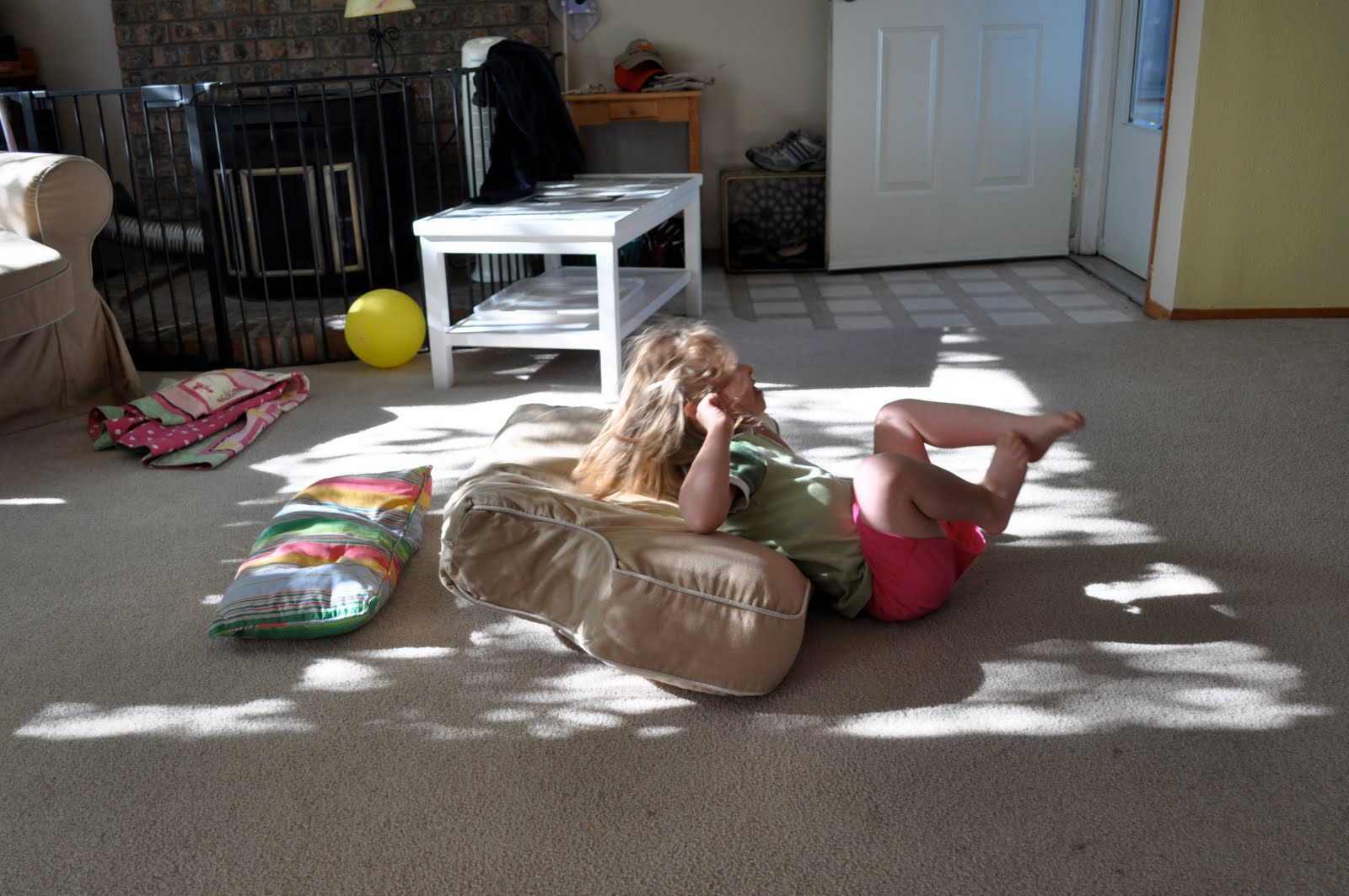
There are often chair cushions and pillows on the floor as Eva constructs her own gym at home. She is practicing a somersault here. Going up...
...and over! Whee!
Every year, we try to get to Seattle for the Folklife Festival. Lots of music and lots of people to watch. And, of course, the massive fountain at the Seattle Center (that doesn't look so big from this perspective, but look closely at the size of the people in the background).
The NW Junior Pipe Band performed. They recently went to a worldwide pipe band competition in Scotland and placed fifth!
Eva cheers, "YAY BAGPIPES!!" She lives and dreams bagpipes.
But she also enjoys dancing and grooving to a stand up bass and fiddle duo. One of the many many musicians Eva stopped to listen to (and talk to and smile and applaud).
Just hanging out in the play set at home, being happy and silly.
Happy Spring, Everyone!!
Friday, December 12, 2008
HealthNewsDigest Article
| New Tests for Down Syndrome Could Lead to More Abortions By Mary Carmichael | NEWSWEEK Dec 7, 2008 - 10:30:38 AM | Email this article Printer friendly page |
Ben Allard is now 9, and it's hard to understand why doctors were convinced he would be such a burden. He's a friendly, witty kid who's happily enrolled in third grade at a regular school. He does, says Beth, "all the things they told us he wouldn't be doing, and more." She shudders when she thinks about how wrong the doctors turned out to be: she almost took their advice and ended her pregnancy.
She would not have been alone in that decision. Life with Down syndrome can be very challenging for both parents and kids, and according to studies, 90 percent of women whose fetuses test positive choose to abort. Now, because of a technological advance, pro-life and disability advocates worry those numbers may rise even higher. Currently, Down syndrome is picked up with blood screens and ultrasounds, then confirmed with invasive tests such as amniocentesis and chorionic villus sampling, which insert needles into the uterus and slightly increase the risk of miscarriage. Some women forgo the tests for that reason. Next year, though, new, noninvasive genetic screens that pose no harm to fetuses or mothers may start arriving in doctors' offices. If they become common, they could result in more diagnoses, more abortions, a dwindling Down population and a drop in support for families who carry to term—what Down activist Patricia Bauer has called "the elimination of an entire class of people." Even now, only 5,000 babies are born with the syndrome each year.
As technology has advanced, doctors' education about Down syndrome has lagged behind. Allard's tactless pediatrician gave her an outdated book that used the pejorative term "mongoloid." Many doctors seem unaware that early intervention with speech and occupational therapy, combined with medications or corrective heart surgery, has allowed some children to grow up relatively normally, graduating from high school and holding jobs. In a large 2005 survey, mothers of children with Down syndrome said they had received little or no information about the positive side of the condition. (Families often end up stronger. A 2003 study in the American Journal on Mental Retardation found that healthy siblings are highly empathetic; another study in the same journal this year showed that parents are less likely to divorce.) Doctors were also in the dark. "Even among obstetrics fellows, 45 percent said their training in how to deliver a diagnosis was barely adequate or nonexistent," says Dr. Brian Skotko, a pediatrics resident at Children's Hospital Boston who has studied how doctors tell patients about sensitive diagnoses. In a 2000 study published in Prenatal Testing and Disability Rights, 23 percent of doctors admitted trying to influence mothers' decisions, usually encouraging them to abort.
Until this fall, a bill based on Skotko's research—one calling for doctors to provide "accurate and up-to-date information" about Down syndrome to expectant parents—had been stalled in Congress. The new noninvasive tests "put it on the front burner and turned up the degrees," says Skotko. (So did Sarah Palin's rise; Sen. John McCain became a cosponsor shortly after naming Palin, who had a baby with Down syndrome in April, as his running mate.) The bill passed easily in September. "It was a rare political moment," says Skotko. "The pro-life people believed that women making informed decisions might be more apt to continue their pregnancies. And people who were pro-choice saw the bill as pro-information but not telling doctors what to do." There's no funding for the new law yet, but disability advocates hope it will go into effect around the same time the new genetic tests do.
The Allards are among those supporters. They testified on the bill's behalf, hoping to show lawmakers the kind of life they believed their doctors hadn't told them about. They have a strong marriage, a healthy second son and a great sense of relief that they have their first one. Ben has something good, too—a new pediatrician.
www.HealthNewsDigest.com © 2008
www.HealthNewsDigest.com
Wednesday, September 3, 2008
Sunday, August 31, 2008
It DOES matter what you say
This was copied from a friend's blog. Please consider what you think about people with Down syndrome and educate yourself and others. Thank you.
FOR IMMEDIATE RELEASE
Contact: Sarah Schleider
212-763-4369/ 917 921 9889 (cell) sschleider@ndss.org
Governor Sarah Palin of Alaska has been selected as John McCain’s choice for Vice Presidential nominee of the Republican Party. Governor Sarah Palin recently gave birth to her son who has Down syndrome. The Palins knew before their son’s birth that he would have Down syndrome.
Below are tips for the proper use of language for ‘Down syndrome’. The National Down Syndrome Society and the National Down Syndrome Congress encourages all media to use the below language:
• Down vs. Down’s. NDSS and NDSC use the preferred spelling, Down syndrome, rather than Down’s syndrome. While Down syndrome is listed in many dictionaries with both popular spellings (with or without an apostrophe s), the preferred usage in the United States is Down syndrome. This is because an “apostrophe s” connotes ownership or possession. Down syndrome is named for the English physician John Langdon Down, who characterized the condition, but did not have it. The AP Stylebook recommends using “Down syndrome” as well.
• People with Down syndrome should always be referred to as people first. Instead of “a Down syndrome child,” it should be “a child with Down syndrome.” Also avoid “Down’s child” and describing the condition as “Down’s,” as in, “He has Down’s.”
• Down syndrome is a condition or a syndrome, not a disease.
• People “have” Down syndrome, they do not “suffer from” it and are not “afflicted by” it.
• It is clinically acceptable to say “mental retardation,” but you may want to use the more socially acceptable “cognitive disability” or “cognitive impairment.”
Down Syndrome Myths and Truths
Myth: Down syndrome is a rare genetic disorder.
Truth: Down syndrome is the most commonly occurring genetic condition. One in every 733 live births is a child with Down syndrome, representing approximately 5,000 births per year in the United States alone. Today, more than 400,000 people in the United States have Down syndrome.
Myth: People with Down syndrome have a short life span.
Truth: Life expectancy for individuals with Down syndrome has increased dramatically in recent years, with the average life expectancy approaching that of peers without Down syndrome.
Myth: Most children with Down syndrome are born to older parents.
Truth: Most children with Down syndrome are born to women younger than 35-years-old simply because younger women have more children. However, the incidence of births of children with Down syndrome increases with the age of the mother.
Myth: People with Down syndrome are severely “retarded.”
Truth: Most people with Down syndrome have IQs that fall in the mild to moderate range of intellectual disability (formerly known as “retardation”). Children with Down syndrome fully participate in public and private educational programs. Educators and researchers are still discovering the full educational potential of people with Down syndrome.
Myth: Most people with Down syndrome are institutionalized.
Truth: Today people with Down syndrome live at home with their families and are active participants in the educational, vocational, social, and recreational activities of the community. They are integrated into the regular education system and take part in sports, camping, music, art programs and all the other activities of their communities. People with Down syndrome are valued members of their families and their communities, contributing to society in a variety of ways.
Myth: Parents will not find community support in bringing up their child with Down syndrome.
Truth: In almost every community of the United States there are parent support groups and other community organizations directly involved in providing services to families of individuals with Down syndrome.
Myth: Children with Down syndrome must be placed in segregated special education programs.
Truth: Children with Down syndrome have been included in regular academic classrooms in schools across the country. In some instances they are integrated into specific courses, while in other situations students are fully included in the regular classroom for all subjects. The current trend in education is for full inclusion in the social and educational life of the community. Increasingly, individuals with Down syndrome graduate from high school with regular diplomas, participate in post-secondary academic and college experiences and, in some cases, receive college degrees.
Myth: Adults with Down syndrome are unemployable.
Truth: Businesses are seeking young adults with Down syndrome for a variety of positions. They are being employed in small- and medium-sized offices: by banks, corporations, nursing homes, hotels and restaurants. They work in the music and entertainment industry, in clerical positions, childcare, the sports field and in the computer industry. People with Down syndrome bring to their jobs enthusiasm, reliability and dedication.
Myth: People with Down syndrome are always happy.
Truth: People with Down syndrome have feelings just like everyone else in the population. They experience the full range of emotions. They respond to positive expressions of friendship and they are hurt and upset by inconsiderate behavior.
Myth: Adults with Down syndrome are unable to form close interpersonal relationships leading to marriage.
Truth: People with Down syndrome date, socialize, form ongoing relationships and marry.
Myth: Down syndrome can never be cured.
Truth: Research on Down syndrome is making great strides in identifying the genes on chromosome 21 that cause the characteristics of Down syndrome. Scientists now feel strongly that it will be possible to improve, correct or prevent many of the problems associated with Down syndrome in the future.
For more information visit: www.ndss.org or www.ndsccenter.org
Monday, April 28, 2008
Seattle Times Article
The Times did an article about Down syndrome, aging and a new civil rights movement. Click HERE to read it.
Subscribe to:
Posts (Atom)